Friday, 27 May 2011

A Real Football Hero.

Having said I don't normally 'do' topical here we go again. The Ryan Giggs affair really set me going and here's why. I personally quite admired the guy, so I view his antics with both surprise and disappointment. (Ryan Giggs, professional footballer, married, father of four has a 'liason/affair' with a young lady and tries to use the full force of the law to stop anyone from being aware of his antics. Says he's thinking of his children. Bit late, Ryan, what a hypocrite!)
To those who say his private life is his own business, I say rubbish, we're entitled to know. This man earns millions from football and even more millions as a 'whiter than white' ambassador for football. He is, like it or not, a role model for millions of children.
My background is ordinary, working class village boy born in the first months of the war. Plus I was orphaned at the age of thirteen. Role models have always been important, particularly where young males are concerned; in my case, because of my circumstances doubly so. The like of Reg Harrison, footballer was particularly important in my formative years. Contrast Reg's career with the spoilt, prima donna's of the modern footballing world.
Reg Harrison was a young man, a keen, honest Derby born and bred professional footballer aged nineteen in 1946, playing for Derby County in the immediate post war years. In an era of shortages there were special problems for professional sportsmen and women. Sport is reliant on fitness; diet is a critical factor if success is to be achieved. Footballers were allocated no extra rations yet a level of fitness was maintained creditable in the extreme. True, there was the occasional perk of extra meat from a butcher in return for match day tickets. There was also a Derby County team manager who was in the catering trade, providing the players with a meal once a week, tripe and onions being a particular favourite. But there were no massive wages to supplement the player's diet, even had extra rations been available.
Reg signed a contract in 1946 for the princely sum of ten pounds a week. The manager somewhat apologetically explained that only long term first team regulars were paid more, he, Reg was what was termed ‘a slider', any increase, and small at that depending on regular first team football. In fact a member of Reg’s family earned more after stoppages working as a foreman in the local Rolls Royce factory. Which would suggest that admired they might well have been, but immediate post war footballers were seldom financially secure. Reg never forgot the club director, an accountant by profession who solicitously inquired, shortly after Reg married as to whether he was saving his money. As Reg inevitably retorted, ‘Chance would have been a fine thing on footballer’s wages’.
Reg lived with his parents until he married and then moved to a small house in the town, from where he walked to work. Not that he considered training twice a day preseason and playing twice a week in season as work. A hard life physically, but one he enjoyed just the same. A life that brought the reward coveted by all British footballers. A FA Cup appearance with the ultimate reward, a cup winner’s medal. For in 1946 Derby County reached the FA Cup Final, meeting Charlton Athletic at Wembley on Saturday the 27th April.
Tickets for the match were eagerly sought by a Derby population starved of real football excitement for almost six long war years. Prices ranged from 3/6 (17p) to £2 2 0s (£2 10s). Derby County were allocated 12,000 tickets, applications by post only, though season ticket holders were assured of a seat. Some travelled on the thirteen special trains travelling from Derby minus a ticket. In fact some 10 6d (52 p) tickets were changing hands before the match for £10 10s (£10 50s). The idea that these were times devoid of football disorder was somewhat questioned when hundreds attempted to gain free entrance just before the match and had to be dispelled by mounted police.
Prior to the match the team stayed at a hotel in Harpenden, four to a room; Reg shared with Angus Morrison, Chick Musson and Jim Bullion. Normally the team had tea and toast for breakfast plus a meal before a match of boiled fish or chicken. On this illustrious occasion they had the luxury of breakfast in bed; egg and sherry mixed with milk and sugar before a coach took them to Wembley Stadium. Each player was allocated two tickets, not over generous when one considers the crowd numbered one hundred thousand.
Derby won a memorable match 4-1 after extra time. An extraordinary game made even more so when the ball burst, a rare occurrence indeed. The team stayed overnight again at Harpenden and played Arsenal in London the following Monday.
On Tuesday 30th April 1946 the conquering heroes were paraded round Derby to rapturous acclaim on the back of an Offilers Brewery wagon; from the Blue Peter Public House in Alvaston to the Police Building in Full Street. The following day Derby played another league match and yet again the following Saturday. Counting from the Saturday before the Cup Final Derby County played six games in fifteen days. The players received their normal wages plus an inscribed Royal Crown Derby plate; the pampered existence of modern footballers a far-cry away.
I still see Reg at the Derby County games. He is over eighty years of age. (There are two Derby County survivors from the cup final game, Reg and Jim Bullions.) A lovely, unassuming, modest man, married for many, many years; thanks for the memories, Reg. You may not be rich but you are still greatly admired. You put the likes of Ryan Giggs to shame.


THE CUP FINAL


Friday, 20 May 2011

If Only They Could Talk.

Nothing very intellectual this week. Stand up the man who said 'How do you mean this week!' I sat wondering what to write about, I never find it easy. People who find something to say every day amaze me. But good luck to them although its not for me. But I digress. I looked round my room where I work for inspiration. And there it was. My latest addition to my collection/museum. One knife cleaner, circa 1880 I reckon, bought from a car-boot in Castleton a week or two ago. The sort of thing that would be used by servants in the 'big houses' many years ago. And I got to thinking, what a story it could tell if it could talk. Where did it come from. Where's it been for the last few years. Who used it over the years. What's happened to the people who used it. It's got a Manchester inscription on it but that doesn't mean it's always been in the area. (Although Castleton isn't that far from Manchester.) So many questions, so few answers. Any suggestions.
Also near my computer, another of my treasures. (Nothing ever gets put away, but it brightens up my little unimportant life !) A butter churn, marked with the name 'Blow'. Funnily enough e-bay is full of them! I reckon its around a hundred years old but I might be wrong, I'm just a daft old collecter, not an expert! Again where's it been, who used it; I'm sure it could tell a tale. I keep meaning to give it a try, it might amuse the grandchildren. Anybody any experience out there on what to do. I've only got a rough idea. Grumpys blast from the past. Next week, two old toys that might amuse!

Thursday, 12 May 2011

It Made Me Think.

I don't normally 'do' political or topical in this blog. Too many others to compete with who do it better. Plus I don't normally concern myself with matters I can't really change. (My paltry readership figures suggest perhaps I ought to change. Is my blog in need of a shake up I wonder.

There have been millions of words written concerning the Osama Bin Laden affair, but not by me. Then at the weekend something happened that made me think.

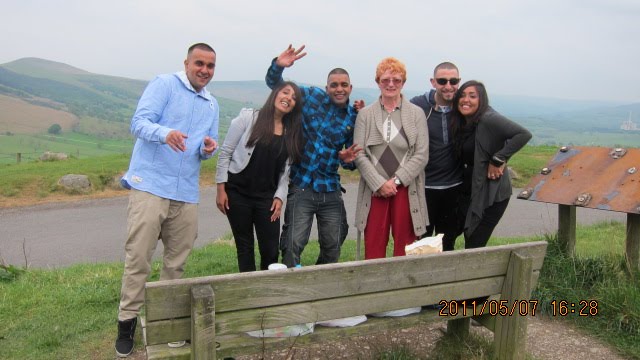
We, my wife and I happened to be in Castleton at the weekend. Situated in a wild unspoilt area in the Peak District, I am so in love with the place I have a large picture of it on the back of my motorhome. (Even though the powers to be in their infinite wisdom have innundated parts with parking meters. Yet there was NOT ONE single vehicle now parked in the areas in question where previously there would have been dozens.) Exactly the place to 'chill out' and many do so, particularly at weekends, including our new found friends parked alongside.

Five youngsters, ages twenty to twenty five, three male, two female. In the course of the next half hour I learnt four were Pakistani, one Moroccan. I also learnt all were well educated, being either at university or in jobs of some standing, banking, teaching, computing. They were also exceedingly well turned out, very modern, very western, but not sporting the hiking paraphernalia normally associated with the Peak District. They were noisy, verbose, outgoing, seemingly unaware of the attention they were getting from less than impressed, often elderly visitors to this area. But they were also courteous, polite, respectful to my wife and I, intelligent and humorous. Their offer of strawberries and cream was unneccessary, but generous and accepted.

It was obvious the group had little comprehension, understanding or experience of the area. (They are city dwellers, Birmingham and Sheffield.) The visit was to be short, for the pull of city life was strong. The talk was of visiting Leeds, presumably to experience the night life or Sheffield, to buy shoes. (On a Saturday evening, surely not viable, my friends!) Eventually they left and quiet returned to Castleton. But why should our chance meeting have any political implications?

Our new friends are young. They are respectful of their parents, in spite of behaviour at odds with their upbringing; (They were in Castleton to get away from 'their own'.) At least one talked of arranged marriage without rancour or particular apprehension. We are old, not of the Muslim faith, pursuing a British way of life; trips to the great outdoors included. We had little in common, but then again the parents of our friends are old. Herein lies the crux of the matter.

The likes of Muslims like Bin Laden has caused the world much misery and fear and the terror is ongoing. Fundamentists amongst the old are probably entrenched beyond redemption. That you can convince some young that virgins are on offer in return for suicide bombing appeals evidently to the brainwashed, particularly the uneducated. But my new friends have the advantage of education. Plus they are at odds with the older generation of whatever political political or religious persuation. Perhaps, only perhaps, the peaceful future of the world depends on the young, my new friends included. Concerning Pakistan,

David Aaronovitch posed the question in The Times last week, 'Whether over time Pakistan will become more like us, or we'll become more like them'. Not a thousand miles removed from our trip to Castleton. You were great, my friends, I hope we meet again. Next time hiking boots and rucksacks at the ready?

Friday, 6 May 2011

April Showers. Grumpys Alternative News.

Where to start?
We are all interested in 'dosh' so I reckon some 'money' stories. I see the Church of England was one of the most successful investors last year, returning 15.2% on its investments.The RC's aren't doing so well, a cross and ring belonging to Pope Paul VI is on E-Bay, starting price £522,000 and an RC priest in Connecticut stole $1 million of church money to fund a lavish life style, including male escorts.
A scam involving the Chinese 'reassembling' scrap German Euro coins was worth at least £20 million whilst a woman in a London divorce court was awarded a mere £2.8 million. Not bad though for eighteen months marriage! I see David Frost is selling 300 bottles of wine, expected to fetch £120,000 whilst the piano used by Paul McCartney to write Yesterday fetched £150,000 in a London auction. At least these immensely rich sellers will get their money, which is more than can be said for those having money in a bank in Lucknow. Termites ate 10 million rupees in notes (£137,000) stored in a steel chest.
Kelly Fannin, a 'professional' thief at least got value for her ill-gotten gains. Never employed, aged thirty-three, her spendings included £4,500 on breast enlargements. About as bright as the moustached, deer-stalking robber of two convenience stores in Sheffield. Later unmasked as Alison Lee, aged forty two. Oh well, worth a try!
All reported in the Times. How interesting the same paper reported the Athenaeum sacking a butler for stealing barbecue leftovers. It is indeed a world of the 'haves and the have-nots' I fear.

Now for the award of 'plonker(s)' of the month.
The Chief Constable of Devon and Cornwell who left his valuables in his car overnight. I know it shouldn't happen, but was he surprised when his radio and personal belongings 'walked'. Plus the 20,000 drivers of police diesel vehicles in this country who filled them up with petrol; average cost of repair, £93-£960. You and me pay of course, not the drivers!
The Indonesian politician involved in the passing of strict pornographic laws. Only to be caught on film staring at porn websites by a photographer. Oops! And the Czech President, Vaclas Klaus, caught on camera pocketing a pen belonging to his Chilean counterpart, Sebastian Pinera. Oops again!


A short spiel on traits in countries that I find alarming.
The French for their frightening arrogance. (My Mother in law is French and a wonderful woman. in case she reads my blog!) They are fighting new rules that do not permit the drinking of wine by riot police whilst on duty. (Frightening that someone would even try to defend such privileges.) We British are as bad. Note the behaviour meted out to Ian Tomlinson in London presumably by riot police that presumably hadn't been drinking.)
Austrians who baked cakes and decorated them with Nazi themes. Its the fact that they don't see it as offensive that I find most alarming.
Americans who allowed their six year old to take a loaded gun into school, which he promptly dropped in the cafeteria, injuring three children. And likewise the parents of an eight year old boy who sold his father's gun at his school in Flushing Queens for $3.00. Plus I presume the eight year throwing a tantrum at school in Denver was a problem. But did the police really have to use a pepper-spray and handcuffs to subdue him?
The world is full of blinkered, unthinking individuals. And Britain has its fair share of those too. A teenager was impaled on railings after a cycling accident in Barnstable North Devon. The council's reaction? Send him a bill for damage caused! It's no good apologising afterwards, think for goodness sake. But there are people and places that cheer me up in an often god forsaken world.
Laura Vikmanis, left by her husband for a younger women. Did she mope; did she heck. She became a cheerleader and is now the oldest cheerleader in the American National Football League at the age of forty two. Good on yer, gal! (Her story soon to be a Hollywood film.)
The Australian tribunal that decided British teacher Luke Webster was unfairly dismissed for trying to to teach non-English speaking students the correct (some might say incorrect) use of the F-word. Come on, fellas, it's not as if Australia is exactly the home of the Queen's English, elocution and all that!
Pc David Rathband, blinded by the gunman Raoul Moat. Who, completely lacking self-pity, competed in and completed the London Marathon. And the group of British servicemen amputees who trecked unsupported to the North Pole. (Joined for part of the journey by Prince Harry.)
The whole of Mexico who, contrary to expectation, came out top in a league of hard workers. (Organisation for Economic Co-operation and Development.) They work longer than other nations and are still the third happiest nation in the world.
Still on a happyish note let our animal friends have the last word. The RSPB are using plastic puffins to lure the real thing back to Ramsey Island after being absent for one hundred years.
A Hertfordshire farmer is puzzled as to why his thirty seven white ewes and one white ram has produced sixty black lambs. (It might be worth checking nearby farms!)
A gorilla called Komale in Bristol Zoo surprised everyone by picking up a duckling and cuddling it. Amazing, but as they say in Derbyshire. 'Don't push your luck, ducky!'
Nonja the orang-utan had some Lego blocks for his birthday. He normally does paintings, his keepers in Vienna Zoo hope the blocks might encourage him to move on to sculptures.
Finally, who can resist the picture of the dog (plus his 449 companions) rescued by activists on his way to a restaurant in Jilin to be served as the plat du jour.


And finally, finally, a piece of mind-bending unimportance. Men with ring fingers longer than their index fingers are more likely to be rated as handsome by women. (Findings of Camille Ferdenzi, a Geneva psychologist.) Don't say you never learn anything from Grumpy's blog!

Sunday, 1 May 2011

Here Today, Gone Tomorrow.

I have long been concerned with an autobiographical work, hopefully to be finished this year concerning life in the late forties and fifties. (I was born in 1939.) The following is a rough copy of the epilogue. Can you relate to what is almost a list of the period? How many memories can you add that hide in the recesses of my mind? I appreciate it is in a way a very 'British' list, but you all must have your memories, be you young, not so young and those of my readers who are indeed 'quite old!

Remember the past, enjoy the present, cherish the future.

It is often the more subtle, little things in life that indicate the passing of time, ‘the way it was.’
Whatever happened to Spangles, where and when did they go? And the blue bags in crisps or trolley buses complete with poles. Buying shoes entailed having your feet x-rayed, not to be recommended, but an innocuous event at the time. Less aggressive, better mannered times, when AA men saluted and all stood up diligently in the cinema when the National Anthem played. Plus the audience probably knew all the words of ‘God Save the Queen’. Pac a macs, Blakeys and packets of five Woodbines. When cars had side indicators, most goods you bought were marked ‘Made in Britain and the upstairs on double-decked buses were full of smokers.
Change is subtle and sometimes is only remembered in retrospect. How many, myself included remember mother holding us firmly, spitting on a hanky and rubbing furiously inside our ears, painful and humiliating if friends were present!
Gone forever the days when breaks between television programmes meant interludes that fascinated almost as much as the programmes themselves. The potter’s wheel and the pot that was never to be completed; the little white kitten that played forever; plus the soothing effects of Angel Fish or windmills; and my particular favourite, the ploughman and his horse, ploughing for eternity. Jimmy Clitheroe was on the radio on Sunday evenings TV and ‘Sing Something Simple’ was on the radio, or wireless as it was called by many. Small mainly unimportant changes but evidence of transition nevertheless.
I remember black jack fruit salads, Pontefract cakes, sticks of liquorice and the grapes in Carnation and tapioca puddings. Bread and dripping, deliciously salty and cod liver oil plus malt extract spooned out with regular monotony. Spam, which stood for Supply Presses American Meat, yellow fish, Little Miss Muffet junkets and dandelion and burdock delivered by lorry once a week. Where did they all go, and perhaps more important, when?
Spanish root that dribbled disgustedly down your chin, sticks of real, jet black liquorish sticks, a magical laxative.
I remember the days when ‘No spitting’ signs were commonplace, particularly on public transport. So much so that a ‘clever dick’ in a local newspaper was moved to pontificate ‘Gentlemen who expectorate should not expect to rate as gentlemen’.

Memories of trains with a unique smell that blew out soot, real soot. Times when you wore socks not gloves on your hands to keep out the cold. Coats on the bed for added warmth in winter and going to bed in daylight in summer. Omo and Ajax washing powder, Robin starch, Izal toilet paper for the posh and squares of newspaper on a nail for the not so well off. Beecham Powders, Venos Cough Mixture and Iodine; dolly tubs, tin baths and steam, always plenty of steam. Visits from the ‘Pru’ and the ‘tallyman’, both eager to collect money hard earned but easily spent
The days when you had a choice of mild or bitter in the pub. Dark mild to be avoided as the slops of other beers tended to be surreptitiously returned to the mild barrel by some unscrupulous landlords.

I Spy Books, fuzzy felts and basin on your head haircuts; Beecham Pills, Cossor and HMV televisions, Vapex inhalers and Liberty bodices; Zal, Rinso and Quix. Elastoplast and SR toothpaste. Sunlight Soap and Opal Fruits,
Crimpolene, Dacron, drip dry shirts, brothel creepers and bootlace ties.
Roy of the Rovers, goal scorer extraordinaire and Alf Tupper, world class sprinter who trained on fish and chips. Brown paper bags and kites made from newspaper. Plus scrap books, French knitting with the aid of a wooden bobbin and honing one’s tracing skills with the aid of greaseproof paper. Epilogues on the television. Bob a Job Week, bubble cars and Berni Inns. Tiger nuts, locust beans and gob-stoppers that changed colours. Formica, drip dry shirts and H-shaped television aerials dominating the landscape. Lone Ranger masks in puffed wheat packets. Skiffle and the smell of Germicide toilet paper. and collecting BRS lorry numbers. Bus conductors, Sunday dinner with Cliff Michelmore and Jean Metcalfe. Sunday evening and the soothing melodies of ‘Sing Something Simple’ with Cliff Adams.

Summers when it never seemed to rain for weeks on end and winters when snow fell with regular abandon, especially at Christmas.
Our bikes had poor brakes, our sledges no brakes plus we wore no helmets. We climbed trees, slowly and fell out of them quickly. We drank from wells, streams and public fountains and we shared luke warm water with numerous friends from far from clean bottles. We drank cows milk fresh and unpasteurised. We chewed all manner of grasses, bulbs and plants, some species known, others guessed at. We roamed the fields and barbed wire and nettles frequently inflicting pain but soon forgotten.
But the majority of us survived. Happy days! Look back and wonder but look forward too, for it’s not over yet. I'll let Mary have the last word!


Tuesday, 26 April 2011

Some Are Born Lucky. Dead True.

A 'tongue in cheek' story of a man without the royal privileges so prevalent this week.►

“You will get cold feet if you stand about waiting for dead men’s shoes.” Peter Keary


Deadly Serious

There’s no doubt some are born luckier than others. Take Amos Crampton, for instance.
He was born prematurely on Friday the thirteenth, in a small terraced house next to an undertakers in the dead centre of Bury. I suppose you could say Amos hadn’t a chance of happiness. But you would be wrong, dead wrong.
True, he was a sickly baby whom the midwife declared, “Hadn’t a ghost of a chance of survival,” but survive he did.
At death’s door on numerous occasions, he often lay in his battered old pram, shrouded in blankets lest he catch his death of cold. His mother administered to his every need. She was heard to say on many an occasion, “Amos, you’ll be the death of me,” but he survived infancy due to her exceptional dedication.
“Amos, die, over my dead body,” she frequently uttered, “he’s dead gorgeous.” And survive he did.
Amos’s passage through school was, I suppose, unexceptional. Some teachers thought him somewhat dead from the neck up. Any attempts to install in Amos anything more than the educational basics were deemed to be flogging a dead horse.
He would sit, trance like, gazing out of the window, oblivious to the teacher’s oratory offerings, completely dead to the world.
Attempts at change were resisted. Even the threat, “You’ll finish in a dead end job,” merely elicited the thought so succinctly articulated by the illustrious Robert Louis Stevenson centuries previously. ”It’s better to be a fool than dead.”
Not that Amos had ever heard of Robert Louis Stevenson. Or for that matter George Stephenson, or indeed any other Stevenson with a ‘v’ or Stephenson with a ‘ph’, famous or otherwise who had ever lived.
Amos was far more interested in leisure pursuits outside school. He rode furiously down the hills around the town after school, peddling furiously, on his dilapidated bicycle, brakes defunct, a death trap indeed. He nevertheless happily diced with death itself amidst the early evening traffic. And sometimes at weekends he could be found, at dead of night in Piggin Wood, the eerie solitude enough to scare you to death. Plus discovery by the gamekeeper would have ensured you were a dead duck. But the visits were profitable and he would return home dead-beat with rabbits to supplement the Crampton family pot.
Sick and tired to death of school, Amos was thankful to leave. He obtained a job easily, contrary to school expectations, as an apprentice, cum odd job man at the undertakers next door to his home. His greyish pallor, solemn expression and general demeanour made him particularly suited to work at an undertakers, though he was less than balmy about embalming.
Work amongst bodies and flowers he liked, though his tendency towards hay fever meant him sometimes coughing amidst the coffins, so to speak. But he didn’t mind, remembering that old adage, “It’s not the cough that carries you off, it’s the coffin they carry you off in.” For Amos viewed life with macabre irreverence. It might have seemed a melancholy existence to others, but in a way it was Amos’ idea of ‘living on the edge’, permanently having ‘One foot in the grave’ he used to say whilst adopting his best deadpan expression.
The work was hard at times, a coffin plus body being a dead weight. Amos was dead set on doing well but promotion depended on filling dead men’s shoes. The die was cast, for promotion prospects seemed as dead as a dodo. Nevertheless he enjoyed the work so much that he even volunteered to work Bank Holidays when only a skeleton staff was required. On such an occasion he would turn on the radio for company, singing along to such classics as Jimmy Ruffin’s ‘I’ve Passed This Way Before’, Sammi Smith’s ‘Help Me make It Through The Night’ and of course Billy Fury’s haunting ‘Halfway to Paradise’, though not loud enough to waken the dead of course.
But life for Amos was not all work and no play.
Amos was not adverse to the company of the opposite sex, courting Jessica, who lived opposite the cemetery for many a year. But whereas Amos was thought by some to be dead from the neck up, Jessica was definitely dead from the neck down. Their courting therefore was confined to holding hands in the cemetery, together reading the epitaphs on the tombstones. A dead loss from a romantic point of view. Jessica may well have been a dead ringer for a young Greta Garbo, but her lack of passion signalled the death knell for any truly sexual progress. Of any case, the ties to his mother were too strong, ‘until death us do part’ referring to mother rather than Jessica.
Amos also pursued other leisure interests to varying degrees.
He regularly visited his local public house. A creature of habit, dead set in his ways, he always sat in the same seat, drinking only spirits, with a natural preference for brandy, a stiff drink if there ever was one. And a deadly shot in the darts team, he was always in at the death in any competition offering cash incentives.
He read nature books, becoming somewhat of an expert, particularly on the Death’s Head Hawk Moth and the habitats of the Deadly Nightshade. He also read poetry, being so fond of Tennyson’s ‘Charge of the Light Brigade’ that he learnt from memory the entire poem. A huge undertaking, starting of course ‘Into the Valley of Death rode the six hundred.’ And he read novels, Hemingway’s ‘Death in the Afternoon’ being a particular favourite.
He carefully studied the obituaries in the local paper, an interest both personal and professional. Amos worked on the principal, “If you weren’t mentioned, you’d no worries.” Plus any local personages listed could well be a bonus in the very near future.
He visited the theatre, never tiring of Agatha Christie’s ‘Death on the Nile’, the author being on a long list of people he was dying to meet.
Ever the dutiful son, his weekends included visits, in his Sunday best, to the Methodist Chapel round the corner from where he lived. The sermons were often as dry as dust, asking ‘What do we mean by the quick and the dead?’ Plus debating ‘The wages of sin is death’, but Amos did not really mind. It pleased his mother that he attended, and his grandfather, a Sunday School Superintendent would have turned in his grave had he not done so.
In summer he would visit a cousin in Gravesend, conveniently placed for hop picking. An excellent source of extra income in a hot summer, a dead loss when storms persisted. A wet summer signalled the kiss of death to financial gain, though the farmers seemed unaffected by variations in the weather, proving the country aphorism, “You never see a poor farmer or a dead donkey.”
He never made a fortune, did Amos, no gravy train, the undertaking business. He was a proud man, nevertheless. He wouldn’t be seen dead collecting supplementary benefits others thought of as their divine right. He would rather drop dead than accept charity, as he called it. He was at death’s door on several occasions, but always recovered, quoting Mark Twain’s words, “The report of my death was an exaggeration.”
Inevitably mother passed to the other side and Amos himself grew old. His increasing deafness meant a world as silent as the grave. And the end, when it did come, came peacefully, over seventy years after it was first expected.
A happy life; a contented life; a long life. Neither morbid nor melancholy, though others might disagree.
On cold wintry nights when the wind whistles round the back street of Bury, one can feel a ghostly presence in the air, smiling down at any poor soul braving the elements. The elderly nod knowingly and hurry home. The young huddle together on the streets, sometimes apprehensive as they imagine hearing a hearse passing by from an undertakers long since gone. And are they a little afraid, a little nervous, these brave young things of a new generation.
“Dead true, they are!”

Thursday, 21 April 2011

'People Who Need People'.

One of those weeks when nothing comes to mind to make blogging easy. Nothing of world shattering importance happens; at least in my little unimportant world.


I gave three talks last week. (There's Nowt so Strange as Folk.) A dinner club, food plus a speaker. At least the food is always popular! One old lady in the audience was one hundred and one next month. At least she stayed awake. I once asked an organiser if, as they enjoyed it as she suggested, why didn't they participate. 'They can't hear you, they're all deaf' was the reply.


Another group last week was a 'Cancer Self Help' group. a small group, all with the severest problems. Sometimes you don't feel like making an effort of an evening. But this group was one of the nicest groups I have ever met. Not a sign of self pity; lovely, positive people. Sometimes we need reminding that life is not fair, and we need to count our blessings, whatever our beliefs.


On my way to a third group I was lost and stopped on an estate to 'map read'. An elderly Land Rover, with an equally ancient driver hurried past, making noisy contact with my mirror. My destination was a cul-de-sac on the estate, the purpose, a talk to be given at a private house, the audience, all middle class ladies who have been meeting for all of forty years.


I arrived five minutes later and what should be parked in the street, an elderly Land Rover! The driver evidently one of my genteel audience awaiting my offerings on this tranquil night. The talk went well, I never did inform the lady driver of our earlier acquaintance. Go on, what would you have done? I just made sure I went home before the lady in question!


I glanced through my diary entry on this date many years ago. In 1959 I was in hospital with Albert. I thought Albert was remarkable. He happily ate all the 'goodies' people brought me on their visits. I was in no condition to eat anything after a serious motor accident. Albert too had serious injuries after an accident on a demolition site. His eating feat therefore was all the more remarkable as he was bedridden at a peculiar angle due to pelvic injuries. I remember thinking how remarkable were his stomach and bowels.


Twenty six years ago this week I met Bill. Bill was a worldly Geordie individual of dubious skills. These skills included devising a machine that slowed an electricity meter so that the reading bore no true relationship as to the amount of electricity you actually used. I liked Bill and we had something in common. I had an English Bull Terrier, called Buster. Bill too had a bull terrier. Plus we had something else in common. Bill knew Albert, in fact Albert was Bill's brother-in-law. Bill knew Albert very well. In fact so well that Bill went home one Sunday after a drinking session, found Albert asleep on the sofa, took his chance and cut Albert's throat. As you may have realised, Bill didn't like Albert!


A make believe world has its place when we wish to escape the real world for a while. (Went to see Arthur, courtesy of The Times Newspaper. Thoroughly enjoyed it. I suspect people will pre-judge it because of Russell Brand's antics in the past. Oh for an open mind!) But the real world has its characters and its moments. Met a couple who organise marathon running and the like. (Ultrarace) Jen Salter and Rory Coleman. A delightful couple whose dedication to fitness made me feel quite ashamed. (But only for a moment!) Rory has run just short of 1000 marathons, Jen's life involves frequent endurance events, triathlons and the like. Aren't people great, isn't life interesting when you look around you.